
Greentronics – SICAPERMA Pilot 1: Dismantling & Processing
Pilot 1 of SICAPERMA deals with the first practical step in magnet recycling: taking neodymium-iron-boron (NdFeB) magnets out of end-of-life products and delivering them in a form that can be used for remanufacturing. Greentronics, a Romanian company that treats waste electrical and electronic equipment (WEEE), is responsible for collection and dismantling as part of Pilot 1. This article summarises what we collected, how we dismantled hard disk drives (HDDs), and where the process still falls short.
Product streams and intake
Greentronics has operated since 2007 and holds an environmental permit from APM Teleorman, part of the National Environmental Protection Agency (ANPM), for WEEE collection and treatment. End-of-life equipment reaches us through producer responsibility organisations (PROs), local collectors and business customers. We looked at five product groups that contain permanent magnets: IT equipment (HDDs, laptops, servers), small household appliances (vacuum cleaners, coffee machines, hair dryers), electrical and electronic tools (drills, saws, machine tools), air-conditioning units (compressor and fan motors) and large household appliances (washing machines, collected once to recover a 3 kg magnet sample for characterisation).
Hard disk drives were chosen as the representative case study. Each drive holds a fairly large amount of magnet material, and the magnets are relatively easy to identify and consistent in type, which made HDDs a good stream for validating a dismantling method that can later be transferred to the other groups. In the other product groups, the quantities we tested yielded only small amounts of magnet material, and extracting it was more difficult, with correspondingly longer labour times.
From intake to sorted fractions
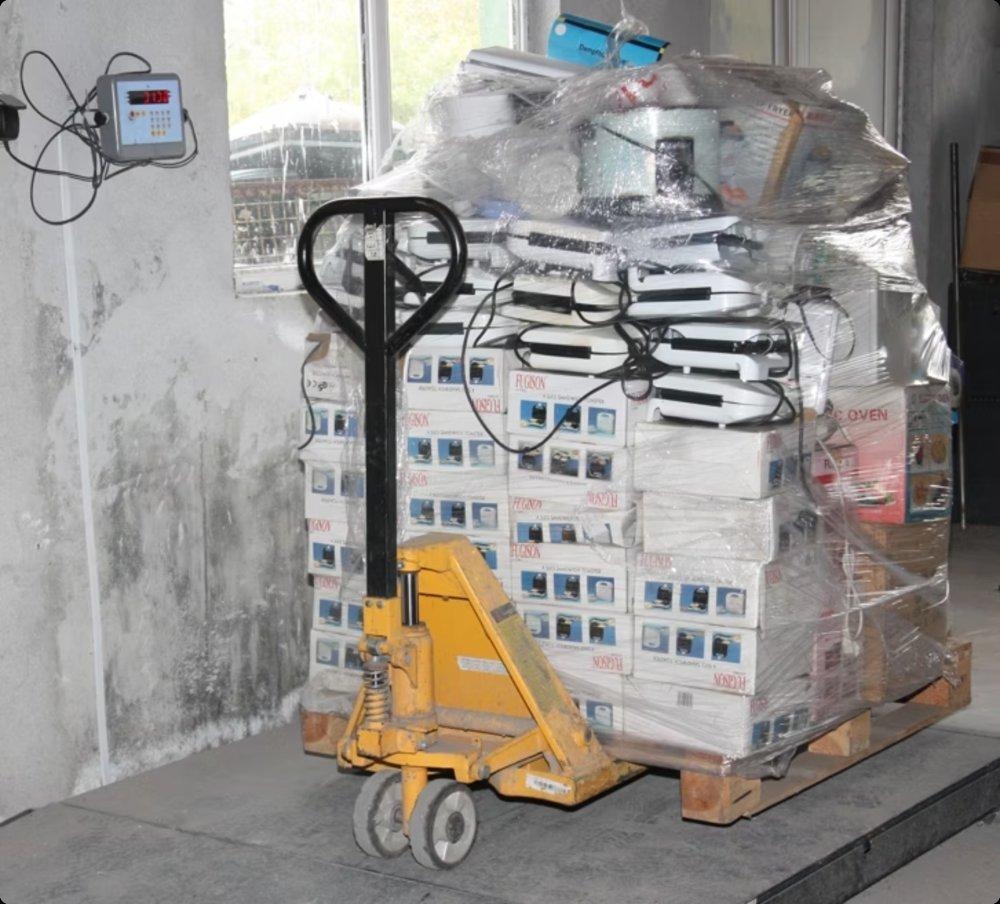
Before intake, a WEEE transport is accepted only if its waste code and transport documents comply with our environmental permit. Once accepted, each batch is identified by device type and likely magnet content, weighed, and separated from other WEEE. Weighing is a legal requirement and is also essential for the project: it provides the mass balance and the traceability of incoming waste and outgoing streams. Operators apply the personal protective equipment (PPE) protocols throughout handling. Batches are mixed in brand, model and condition, so dismantling time and magnet yield vary from one batch to another.
Dismantling workflow
Every product follows the same sequence: assessment, optional data erasure, manual dismantling of the equipment (with the HDDs extracted where present), dismantling of the HDDs and removal of the magnet assemblies, detachment of the magnets from their backing plates, final sorting with a quality check, and packaging. The magnet fraction is packed to specification and sent to downstream partners, including the Pilot 2 magnet production line.
The other output fractions from equipment dismantling (electronic boards, iron, aluminium, coolers, power supplies, plastics and other materials) are sorted by type and sent to separate recycling flows.
For HDDs, data erasure by demagnetisation is available on request. A 10,000-gauss magnetic field is applied to the drives, and a certificate is issued for each batch, recording the serial numbers, date and time, and the result (field strength and pass/fail).
HDD dismantling
HDDs are dismantled entirely by hand. Designs differ too much between brands, generations and form factors for automation to work at present. Manual work also keeps the magnets intact, allows reusable parts to be saved instead of shredded, and lets the operator adapt to each model.
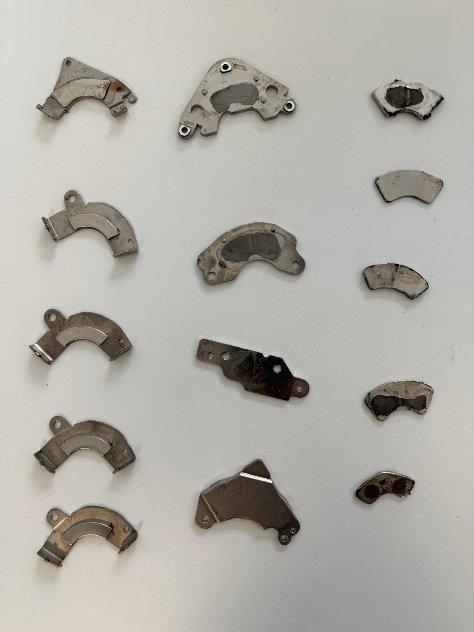
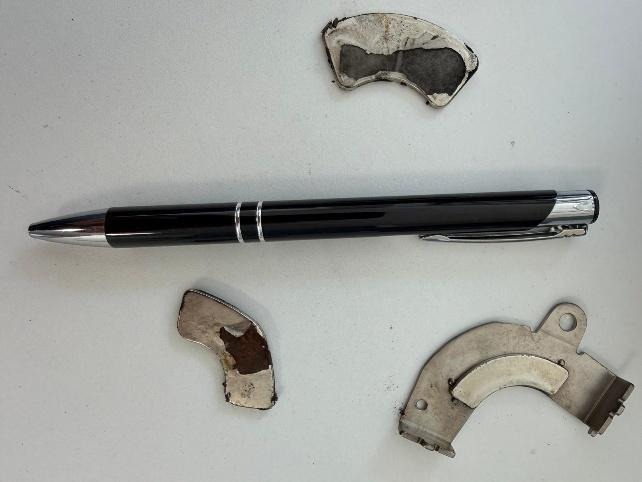
The tools are a pneumatic driver with Torx T6/T8 bits, hand tools (flat-head tools, chisels, needle-nose pliers, a bench vice), a heat gun to soften the adhesive that holds the magnet assembly, and cut-resistant gloves and safety glasses. The steps are: open the drive and remove the external parts; locate and lift the magnet assembly; separate the magnet from its backing plate; inspect and sort by condition; and pack. Depending on whether detachment worked, the result is one of three fractions: intact magnet mount assemblies (detachment not attempted or unsuccessful), separated backing plates, and magnets.

Magnet size depends on the drive. The smallest magnets generally come from 2.5-inch drives, but newer 3.5-inch drives can also have smaller assemblies than older drives of the same size.
Results
In total, 263.2 kg of permanent magnets were delivered to project partners in 13 shipments. The project had set an initial delivery target of50 kg. The extra 213.2 kg was supplied on purpose, to cover losses in downstream steps such as decoating, flake and ingot production, sintered magnet production and process trials. Of the total, 231.5 kg went to MagREEsource for the Pilot 2 magnet production line, and 31.7 kg were sent as samples for recycling trials and characterisation to the Institute of Physics SAS, IMDEA Nanociencia, Metalpine and Universidad de Jaén. All magnets came from HDDs, except for a 3 kg sample from washing-machine motors.
The magnets came from two sources. About 105.3 kg were recovered from WEEE dismantled by Greentronics (including the 3 kg washing-machine sample). The remaining ≈157.9 kg came from 780 kg of HDD magnet assemblies (magnets still bonded to their backing plates) sourced from business partners, on which we carried out the detachment step. Across two detachment campaigns on 820 kg of assemblies, magnets made up 20.2% of the assembly mass.
Greentronics dismantled 114 tonnes of mixed WEEE in the first 18 months of the project (weighed) and an estimated 10.4 tonnes during the following five months, about 124.4 tonnes in total. HDDs were not weighed separately. Back-calculated from the magnets recovered, they amounted to about 4.2 tonnes, roughly 7,600–9,400 drives and about 3.4% of the WEEE. That share is lower than the 5.75% assumed in our theoretical mass-balance model, because the real stream includes PCs and printers without HDDs, as well as missing or damaged drives.
Measurements on sample drives put the magnet at 1.98–2.46% of HDD mass, or about 11–13.5 g for an average 549 g drive, with values from 4.4 g to 28.9 g per drive depending on the manufacturer. The magnets are of the NdFeB type used in HDD voice-coil actuators. We have not run our own compositional or purity analysis, but independent processing by the Institute of Physics SAS confirmed the Nd₂Fe₁₄B phase in the material we supplied.
Using the composition of the WEEE processed (50% desktop PC towers, 5% rack-mounted servers, 45% business printers and multifunction devices), the ≈102.3 kg of magnets recovered from HDDs in our own WEEE stream break down approximately as follows (magnets from purchased assemblies are not included):
| Source of magnets | Share of input WEEE | Estimated magnets | Share of magnets |
| Desktop PCs | 50% | ≈82.6 kg | 81% |
| Business printers and multifunction devices | 45% | ≈7.9 kg | 8% |
| Rack-mounted servers | 5% | ≈11.8 kg | 11% |
Table: Estimated origin of the ≈102.3 kg of magnets recovered from Greentronics’ own HDD stream (Greentronics mass-balance model).
The trials also gave us a repeatable dismantling procedure for HDDs, safe removal of magnet assemblies under real operating conditions with no safety incidents recorded, consistent grading by size, type and condition, and batches packed to specification for the next partners in the chain.
Problems encountered
The plate-and-magnet subassemblies are very small, so handling them by hand is slow and needs care. Design variability is the second problem: even within one manufacturer, different models may use different screw heads (for example Torx 5 and Torx 7) or different fastening methods, so the workflow has to be adjusted repeatedly. Under controlled conditions (same model, intact drive) dismantling times are repeatable. In real WEEE, deformation, adhesives and the lack of standardisation make the times vary a lot. Operators also have to keep speed, safety and data security in balance at the same time.
Lessons learned
Three practical changes had a measurable effect. Choosing suitable driver bits, pry tools and staging fixtures shortened the time per drive and reduced damage to components. Better grip techniques and magnet-safe trays reduced handling errors and made work with strong magnets safer. Standardising the inspection at each stage caught defects early and kept the material grades consistent between batches.
The economics are the main limit, but the bottleneck lies upstream rather than in the HDD dismantling itself. An operator processes 20–30 HDDs per hour, from opening the drive to detaching the magnet, which gives roughly 0.22–0.40 kg of magnets per operator-hour. The magnet, however, is only about 2% of the mass of an HDD, and HDDs made up only about 3.4% of the mixed WEEE we processed, so around 1.2 tonnes of WEEE have to be handled for every kilogram of magnet recovered, and taking the HDDs out of PCs, servers and printers adds further manual work. On these figures, manual dismantling alone is unlikely to be cost-efficient at industrial scale. Full automation is not realistic yet because of the variability of incoming drives, but partial automation of selected steps, especially the extraction of HDDs from host equipment, will be needed, together with better tools and, in the longer term, product designs that make magnets easier to remove. A more structured supply of pre-sorted, magnet-rich feedstock also helps: ready-extracted magnet assemblies from business partners supplied about 60% of the magnets we delivered.
Next steps
Most of the sorted magnets (231.5 kg) are now at MagREEsource, where they will be used in Pilot 2 to make sintered and polymer-bonded magnets; the rest went to partners as samples for recycling trials and characterisation. The method validated on HDDs will be applied to the other product groups: household appliances, power tools and air-conditioning equipment.