
Europe faces a critical challenge in securing its supply of rare earth elements, which are essential for permanent magnets used in everything from electric vehicles to wind turbines and consumer electronics. Currently, the continent relies heavily on imports, creating strategic vulnerabilities. The SICAPERMA project directly addresses this challenge by building a complete, circular European value chain for NdFeB magnets. While significant progress has been made in collecting and processing end-of-life magnets, notably by our partner MagREEsource, who has successfully recovered and characterized material from hard disk drives and loudspeakers. The true test of a circular economy lies in transforming this recycled feedstock back into high-performance products. This is precisely the mission of PILOT 2, where we demonstrate the complete industrial pathway from characterized recycled powder to ready-to-use permanent bonded magnets PBM through polymer compounding and injection molding. Our work proves that 100% recycled magnets can achieve performance levels suitable for demanding applications, offering a viable path toward European sovereignty in this critical material sector.
The challenge: Transforming variable waste into reliable feedstock for high-performance applications
One of the fundamental lessons we have learned throughout the SICAPERMA Project is that successful recycling begins not in the factory, but in the quality and consistency of the input material. The recycled NdFeB powder supplied by MagREEsource comes from end-of-life devices such as hard disk drives and loudspeakers, and like any recycled feedstock, it presents considerable variability in geometry, composition, and magnetic properties depending on the source. This variability could easily become a barrier to industrial processing (or manufacturing) if not properly managed. Furthermore, when the target application is as demanding as traction motors for electric vehicles, the performance requirements become even more stringent. Traction motors require magnets with consistent magnetic properties, excellent thermal stability, and mechanical integrity under operational stresses. Our approach in PILOT 2 has been to embrace the reality of variable feedstock and develop a robust compounding and injection molding process that can accommodate this variability while delivering consistent final products that meet these demanding specifications. The key lies in precise formulation, thorough mixing, rigorous quality control at every stage, and close collaboration with end-users to ensure that the final components satisfy all application requirements.
IMA approach: From characterised powder to Traction motor magnets
The process has developed and validated in PILOT 2 follows a carefully engineered sequence designed to preserve magnetic properties while ensuring homogeneous distribution within the polymer matrix. The ultimate validation of our approach has come through the successful production of magnets for an end-user in the traction motor sector (MAC Puar), a process that required not only technical excellence but also careful attention to dimensional tolerances and integration requirements.
The process starts with the characterized recycled powder from MagREEsource. For the traction motor production run, the starting powder exhibited remanence of 1.18 Tesla, coercivity of 798 kA/m, and maximum energy product of 233 kJ/m³. Knowing these characteristics in advance allowed us to select appropriate processing parameters for optimal final properties.
The first active step is compounding. We precisely mix the magnetic powder with a polyamide binder, selected for its excellent mechanical properties and thermal stability required for traction motor applications. We also incorporate additives including coupling agents, lubricants, and stabilizers. Through systematic experimentation, we identified optimal loading levels that balance magnetic performance with processability.
This mixture then enters a co-rotating twin-screw extruder, where the polyamide melts and the rotating screws ensure each particle becomes uniformly coated with polymer. The extruded material is cooled and then fed into a granulator that produces uniform pellets, after which our masterbatch is ready for injection molding.
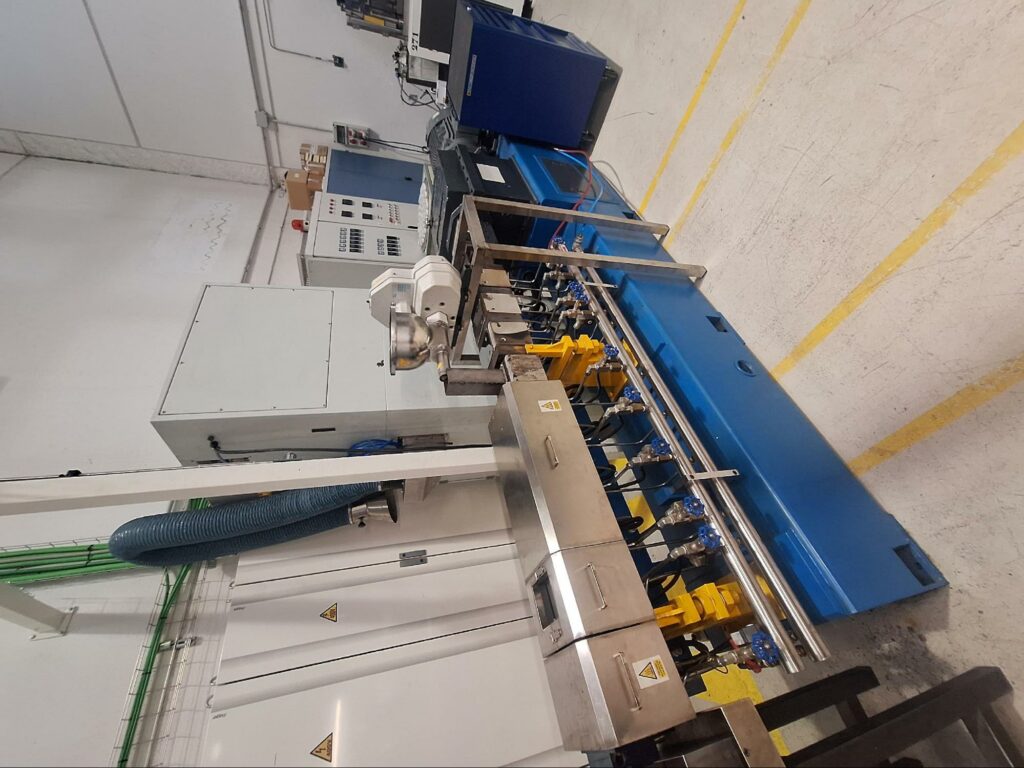
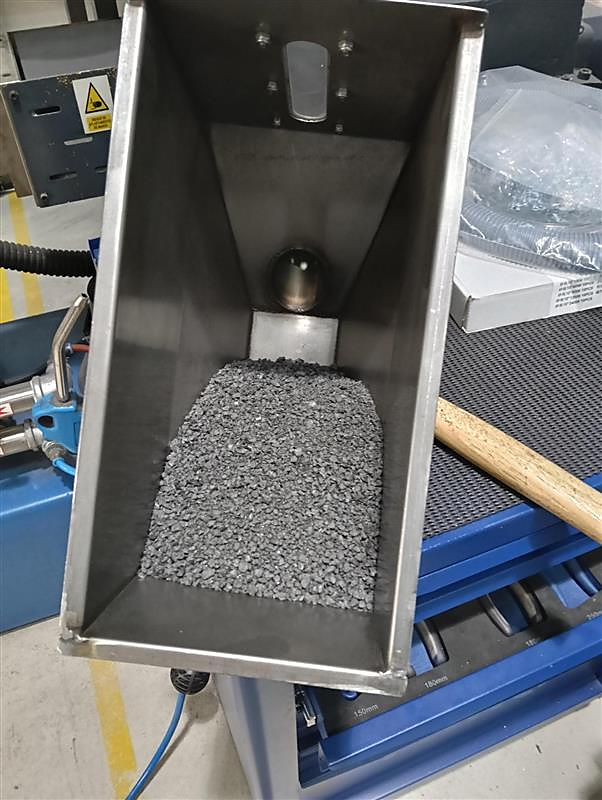
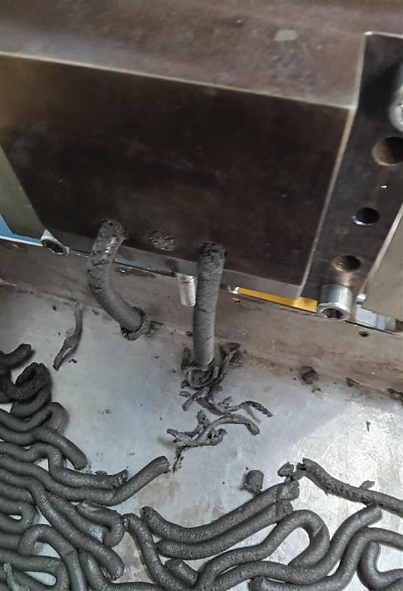
The pellets are then processed in an injection molding machine adapted for magnetic materials. The material is injected under high pressure into a mold cavity while a strong magnetic field aligns the particles in the desired direction. For the traction motor application, we produced disc-shaped magnets that would subsequently be machined into the final block geometry. After cooling, the net-shape discs are ejected. The final stage involved machining these discs into the required block geometry. This operation, performed in collaboration with our end-user partner (MAC Puar), yielded blocks with excellent surface finish and precise dimensions that enabled successful integration into the traction motor assembly.
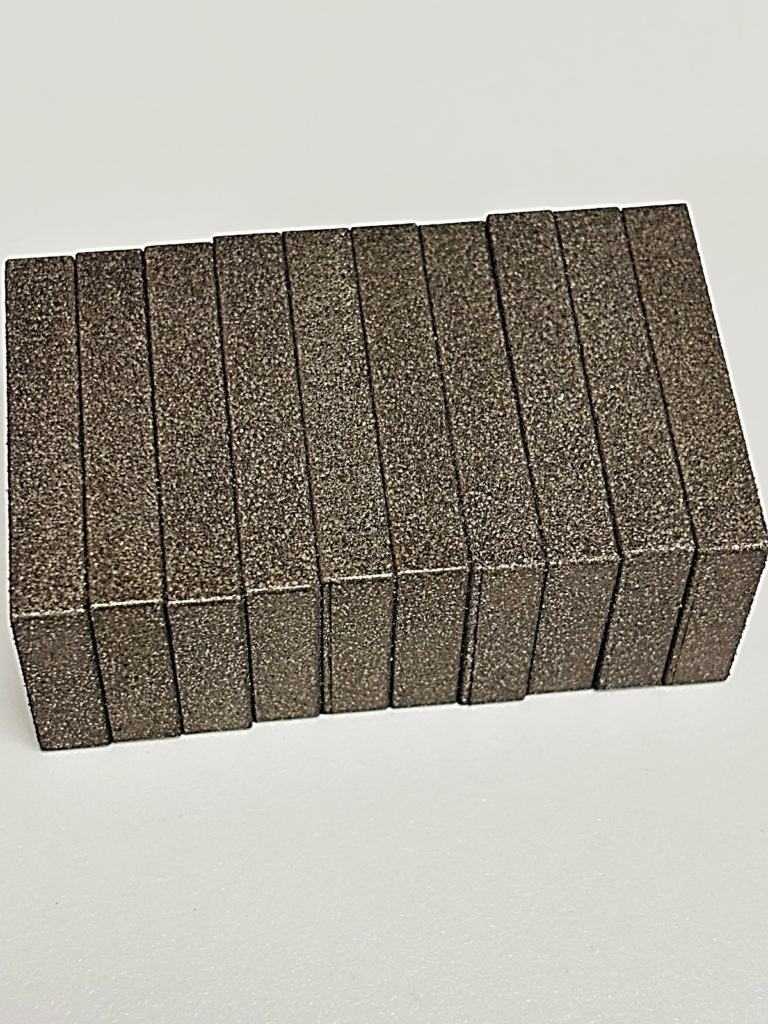
Throughout this process, we maintain rigorous quality control. Finished magnets undergo comprehensive characterization including measurement of remanence, coercivity, energy product, and density. For the traction motor magnets, this quality assurance was particularly critical given the demanding application requirements.
Results: Achieving traction motor specifications with 100% recycled material
Our production run for the traction motor application has achieved a significant milestone in the SICAPERMA circular economy pathway: the successful manufacturing of 100% recycled bonded magnets from end-of-life NdFeB powder.
| Material | Recycled Bonded Magnets |
| Br (T) | 0.633 |
| HcJ (kA/m) | 487.5 |
| (BH)max (kJ/m³) | 44.3 |
| Density (g/cm³) | 4.73 |
These results represent a significant validation of the circular economy approach on the SICAPERMA Project. The magnets, manufactured entirely from recycled feedstock diverted from waste streams, demonstrate that end-of-life NdFeB material can be successfully processed through compounding and injection molding.
Beyond these quantitative results, the most important achievement is the demonstration of a fully functional circular economic pathway. End-of-life magnets, destined for disposal, have been collected, processed, and transformed into new, 100% recycled magnets ready for evaluation in a strategic application. This completes the loop from waste to product and proves that recycled content magnets can be manufactured to specification using conventional industrial processes. The availability of 100% recycled bonded magnets for evaluation opens new possibilities for circular economic solutions in the automotive sector. The upcoming tests will provide valuable data on how recycled bonded magnets perform under real-world operating conditions, informing future development and potential applications.
This achievement represents a concrete step toward reducing Europe’s dependence on primary rare earth imports. By proving that waste streams can be transformed into new magnetic components ready for industrial evaluation, PILOT 2 has validated a model that can be scaled across the continent, turning end-of-life products into strategic resources for European industry.
Lessons learned: Practical insights for industrial implementation
Throughout this project, we have accumulated valuable practical lessons that may benefit others pursuing similar pathways toward recycled magnetic materials. One significant learning concerns the rheological behavior of the molten composite during injection molding. We discovered early in the project that the flow characteristics of material containing recycled powder could differ noticeably from material made with virgin powder, likely due to subtle differences in particle size distribution and surface chemistry. This required a systematic design of experiments approach to identify optimal injection parameters. We found that slightly higher mold temperatures and modified injection speeds compensated for these differences and produced excellent results. This experience underscores the importance of viewing recycling not as a simple substitution of one material for another, but as a distinct process requiring its own optimized parameters.
Another important lesson is related to the handling and storage of both recycled powder and finished pellets. NdFeB materials are susceptible to oxidation, which can degrade magnetic performance over time. We have implemented protocols including vacuum sealing and processing within a controlled atmosphere glove box, ensuring material integrity is preserved throughout the entire production chain. These seemingly minor details are essential for industrial viability, particularly when producing components for long-life applications such as traction motors where performance must be maintained for years or decades.
Conclusion
The work of PILOT 2 has demonstrated conclusively that bonded magnets manufactured from 100% recycled NdFeB powder can be successfully produced using conventional industrial processes. Through careful compounding with polyamide binder and additives, twin-screw extrusion, pelletization, and injection molding with magnetic field alignment, we have transformed end-of-life material into fully recycled magnets ready for evaluation in demanding applications. These magnets will now be delivered to an end-user (Mac Puar) for testing in traction motor applications, providing valuable data on the performance of recycled bonded magnets under real-world operating conditions.
Building on this achievement, IMA will now produce 100% recycled bonded magnets for two additional integration tasks within the project: microwave energy converters for Primum Partner and safety switches for ETRA partner. These applications further demonstrate the versatility of recycled magnetic materials and their suitability for diverse industrial requirements, expanding the circular economic impact beyond a single use case.
Most importantly, PILOT 2 has validated a complete circular economic pathway that connects upstream recycling with downstream manufacturing. End-of-life magnets diverted from waste streams have been processed and transformed into new, functional components ready for industrial evaluation. This proves that recycled content magnets are not merely a laboratory curiosity but a viable reality that can contribute directly to European strategic autonomy in this critical materials sector. We invite collaboration with industry partners and researchers who share our vision of a resilient, sustainable, and competitive European magnet industry built on circular principles.