
Permanent magnets are the silent workhorses of the clean-tech revolution. They are embedded in wind-turbine generators, electric-vehicle (EV) motors, pumps, robots, sensors and most household appliances. Europe’s demand for high-performance magnets is rising quickly, yet most of these components still depend on rare-earth elements such as neodymium and dysprosium. These materials are largely mined and processed outside Europe and have a high environmental footprint. Only around 1 % of Europe’s neodymium–iron–boron (Nd-Fe-B) magnets were recycled in 2022, and China controls about 98 % of global rare-earth magnet supply. This newsletter explains why recycling permanent magnets is urgently needed, outlines Europe’s vulnerability, and highlights how projects such as SICAPERMA and PASSENGER, together with Metalpine’s sustainable powder-production process, are working towards a circular magnet economy.
Europe’s magnet challenge
Heavy reliance on imports and rising demand
European manufacturing of permanent magnets is almost entirely dependent on imported rare-earth materials. Virtually all rare earths used in Europe’s magnets are imported, with around 98 % coming from a single source (China). This dependency exposes European industry to geopolitical risks, trade disputes and price volatility. The EU’s new Critical Raw Materials Act aims to reduce this dependence by ensuring that 25 % of critical raw-material demand is supplied through recycling by 2030. Yet today less than 1 % of rare earths consumed in the EU are recycled.
In addition to supply risks, demand is accelerating. Nd-Fe-B magnets are the strongest commercially available magnets and are used in key technologies for Europe’s green and digital transitions. As electrification expands in mobility, automation and renewable energy, scaling magnet recycling and alternative materials is essential to meet climate-neutrality goals.
Structural weaknesses in Europe
Europe suffers from a structural imbalance: it needs high-quality magnets but has limited domestic capacity to produce or recycle them. The SICAPERMA project highlights that Europe still lacks an integrated Nd-Fe-B value chain and that increasing recycling capacity is the only way to close the gap between soaring demand and limited supply. Trade conflicts or export restrictions could disrupt supply chains overnight and varying environmental and social standards outside Europe make sustainability difficult to control. Without action, shortages of raw materials and finished magnets may slow down e-mobility, wind-power deployment and industrial automation.
The SICAPERMA magnet loop: Building a circular value chain
The SICAPERMA initiative (Sustainable Innovation Investment Catapult for Permanent Magnets) is uniting 11 regions to build Europe’s first interregional value chain for recycled Nd-Fe-B magnets. By connecting collection, processing, magnet manufacturing and product integration, the project aims to reduce dependence on imports and foster industrial resilience. The pilots built during this project establish Europe’s first interregional demonstration ecosystem for permanent-magnet recycling. The project’s goals include achieving technological maturity (TRL 7–9) for Nd-Fe-B sintered and bonded recycling technologies, demonstrating economic viability on an industrial scale and encouraging stakeholders across Europe to engage in a structured recycling ecosystem.
Why recycling matters
Magnet recycling presents both environmental and strategic benefits. Nd-Fe-B magnets contain neodymium, dysprosium and other rare-earth elements whose mining is energy intensive and often associated with significant ecological and social impacts. Recovering magnets from waste streams keeps valuable metals in circulation and reduces the need for new extraction. This approach aligns with the EU’s circular-economy objectives and supports climate goals by lowering greenhouse-gas emissions.
PASSENGER: Pioneering rare-earth-free magnets
While recycling existing magnets is vital, Europe also needs alternative magnet technologies to reduce its dependence on rare earths altogether. The PASSENGER project (Pilot Action for Securing a Sustainable European Next Generation of Efficient Rare-Earth-Free Magnets) addresses this challenge by developing MnAlC and improved strontium ferrite magnets from materials abundant in Europe. This initiative is piloting these magnets in electromobility applications, such as pump motors and e-scooters. The project has demonstrated that high-performance magnets can be produced entirely without rare earths. These new magnets were validated in water-pump and e-scooter prototypes, achieving performance comparable to conventional rare-earth-based systems.
Metalpine’s sustainable powder-production process
Innovative gas-atomisation technology
Metalpine GmbH is a young Austrian company specialised in high-quality spherical metal powders for additive manufacturing and other applications. The company has developed a unique atomisation process that produces satellite-free, highly spherical powders with narrow particle-size distributions and low oxygen content. These powders offer better flowability, fewer pores and higher density than conventional powders, making them ideal for demanding industrial applications.
Closed-loop Argon cycle and reduced waste
Metalpine’s commitment to sustainability is evident in its manufacturing process. The company uses a closed-loop argon cycle gas process with an integrated cleaning mechanism, which greatly reduces inert-gas consumption. The schematic of the process is shown in Figure 1.
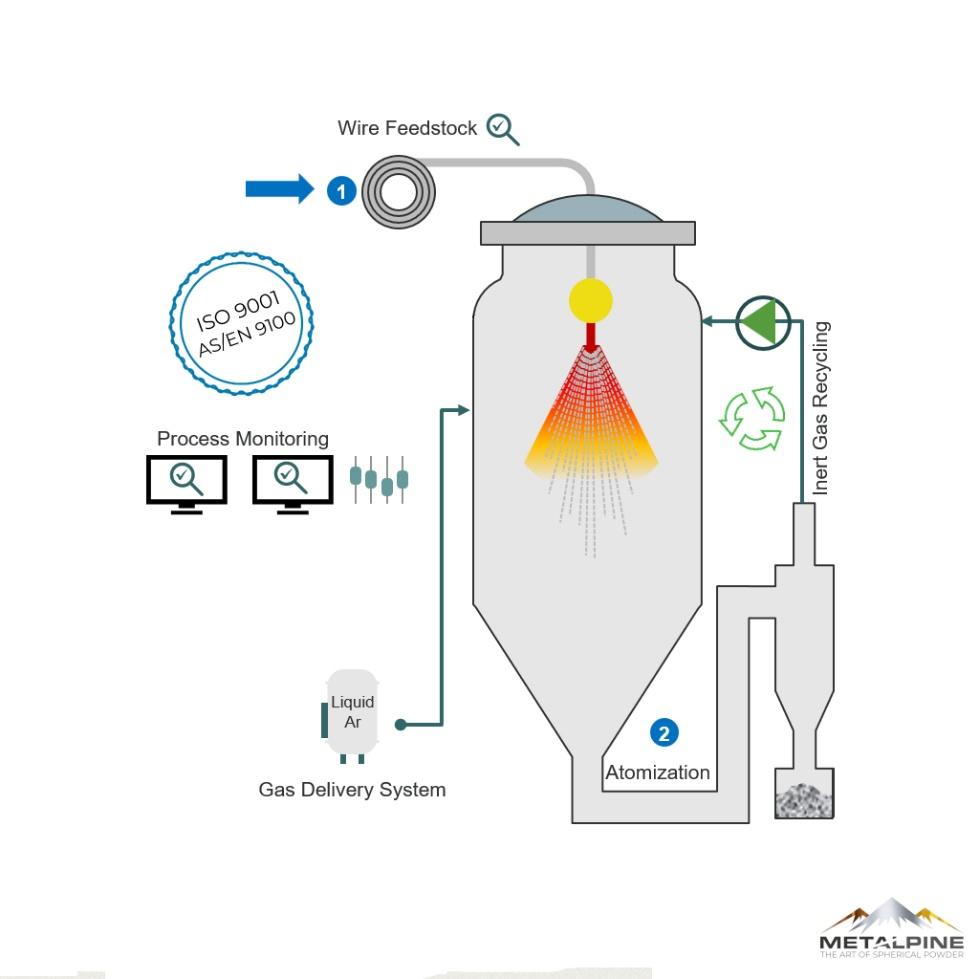
The process also targets narrower particle-size distributions to increase productivity and reduce waste by 20–50 % compared to standard production processes. Additional sustainability features include:
- No dust emissions: production is conducted in a clean-room environment that eliminates dust release.
- Energy savings: integration of the production line into the building infrastructure lowers process energy consumption.
- High safety and health standards.
- Alignment with the United Nations’ Sustainable Development Goals (SDGs), including climate action goals that involve reducing argon use and shifting transport from air freight to rail and sea.
Delivering purity and versatility
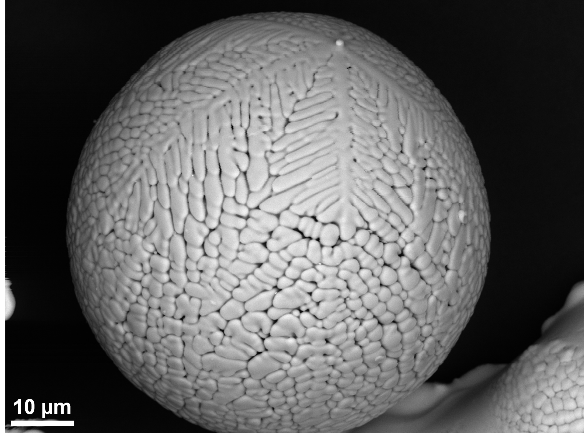
Metalpine’s process yields powders with high purity, high sphericity and density, free of satellites (the small particles that often attach to atomised powders). These properties translate into better packing density and consistent melt behaviour in additive manufacturing. While Metalpine produces powders from a variety of materials (pure metals and also complex alloy systems and refractory metals), its sustainability strategy extends beyond materials. The company emphasises recycling and responsible material use and participates in research projects such as SICAPERMA to push circular economy to a higher level. In the PASSENGER project, Metalpine produced MnAlC powder that was subsequently processed into bonded and sintered magnets, demonstrating the synergy between advanced powder production and rare-earth-free magnet technologies. A SEM image of the produced powder is shown in Figure 2.
Conclusion and Outlook
The world’s transition to clean energy and electrified mobility hinges on a reliable supply of high-performance permanent magnets. Europe’s heavy dependence on imported rare-earth magnets and the current recycling rate of ~1 % highlight the fragility of the supply chain. Initiatives such as SICAPERMA are building the infrastructure for a circular magnet economy, creating pilots for dismantling, recycling and reintegration while targeting 21 plants by 2050 and significant CO₂ savings. In parallel, the PASSENGER project has proven that rare-earth-free MnAlC and improved ferrite magnets can match the performance of conventional magnets while cutting CO₂ emissions by up to 80 % and reducing toxicity.
Metalpine contributes to this landscape through its sustainable argon-cycle gas atomisation process which reduces inert-gas consumption, minimises waste and produces high-quality powders. By supplying pure, spherical powders for both conventional and rare-earth-free magnets, and by participating in collaborative projects, Metalpine demonstrates that industrial competitiveness and environmental responsibility can go hand in hand.
As Europe moves towards green and digital transitions, the combination of recycling, innovation in material science and sustainable manufacturing will be crucial. Investing in circular value chains, adopting rare-earth-free magnet technologies and supporting sustainable production processes like Metalpine’s can help Europe achieve strategic autonomy and reduce environmental impacts.